
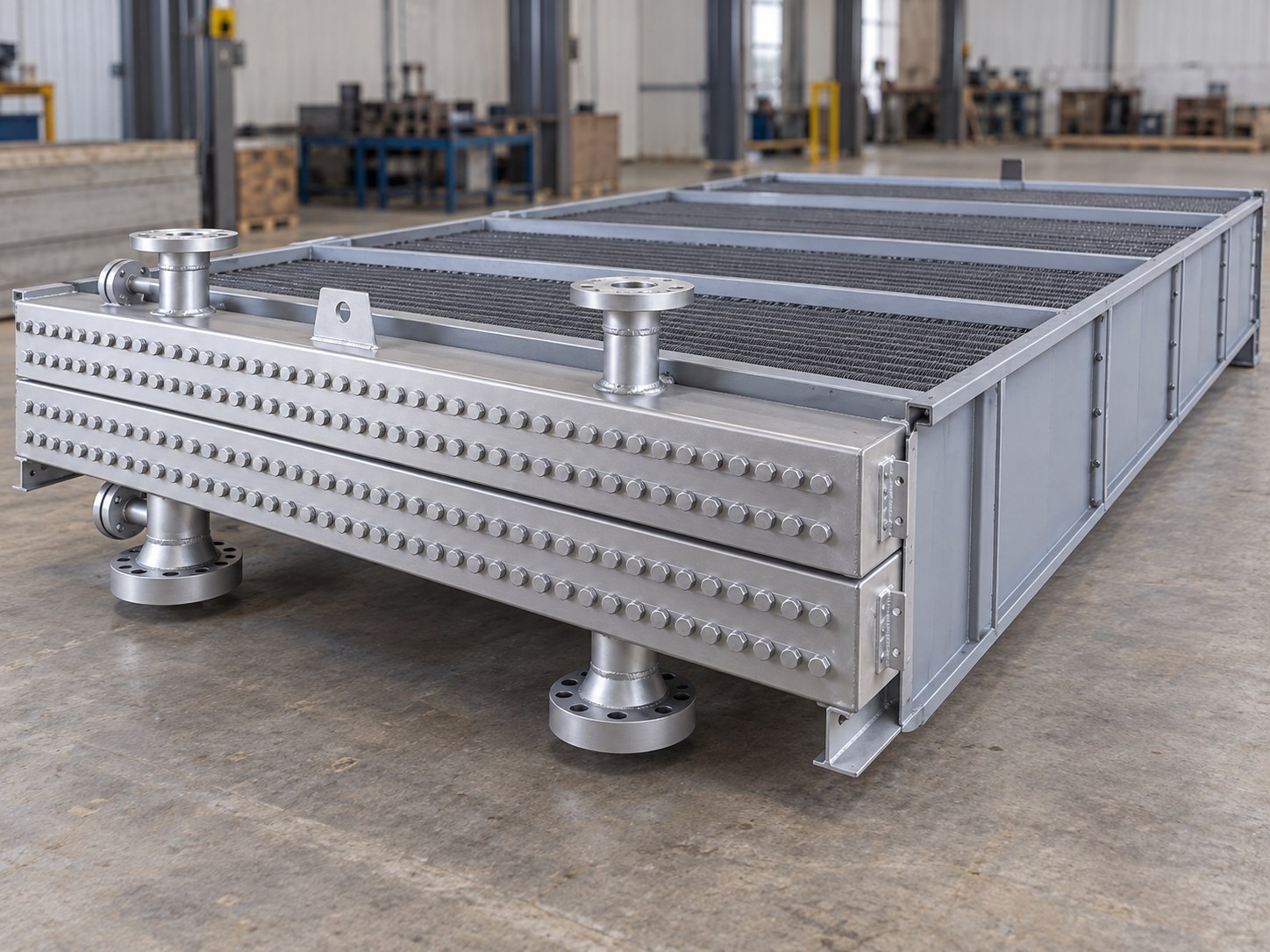
 Finned tube bundle and headers. Fans, structure and final package scope are project specific.
How Air Cooler Heat Exchanger works
An air cooler transfers process heat through finned tubes to ambient air moved by a fan system. Design combines process duty with design ambient temperature, pressure drop, air flow and noise limits. Header type, tube/fin selection, structure and maintenance access are engineered for the specified site conditions.
Ambient conditions drive the cooler design
Air cooler duty depends on process fluid properties, flow and temperature, site design ambient, required outlet temperature and allowable pressure drop. Fan arrangement and finned tube area are evaluated together, including turndown, noise and power availability. Header type, tube material, access for cleaning and structural loads follow the mechanical specification. Provide the warmest design ambient and the critical operating cases, as cooling performance changes with weather.
Developed for the operating duty
Typical applications
- Process gas and liquid cooling
- Early production facility packages
- Cooling where water consumption must be limited
Inputs for engineering
- Fluid flow, composition and thermal duty
- Design ambient temperature and air-side constraints
- Allowable process pressure drop, fouling and noise criteria
What the package can include
- Finned tube bundle and header configuration
- Fan, motor, drive, structure and vibration considerations
- Mechanical testing and project documentation
Final sizes, material grades, pressure classes, makes, testing and documentation are specified in the approved technical offer. We coordinate applicable design, fabrication, inspection and quality records against the project requirements.
How is the required bundle size determined?
Thermal sizing uses the process conditions and site design ambient; final bundle and fan selection follow the agreed calculation basis.
Air cooled heat exchanger or water cooled exchanger?
An air cooled heat exchanger rejects heat to ambient air through finned tubes and a fan system. It may be suitable where cooling water is limited, but the achievable outlet temperature depends on the site design ambient and selected thermal approach. A water-cooled shell and tube exchanger instead depends on the available cooling-water conditions and water-side maintenance requirements. Compare utility availability, seasonal conditions, plot space, noise, power and lifecycle maintenance before selecting the cooling method.
Specify an air cooler for your process duty
For an air cooler quotation, share fluid composition and flow, inlet and target outlet temperature, operating and design pressure, allowable pressure drop and fouling assumptions. Include site ambient conditions, elevation, hazardous-area requirements, power supply, noise limits and structural design cases. MechOilfield reviews finned-tube, header, fan and support requirements against this basis. Final dimensions, materials and performance requirements are established in the approved technical offer.
Need design services only?
Explore our design and engineering services for calculations, modelling and fabrication drawings, or contact our team with your equipment scope.